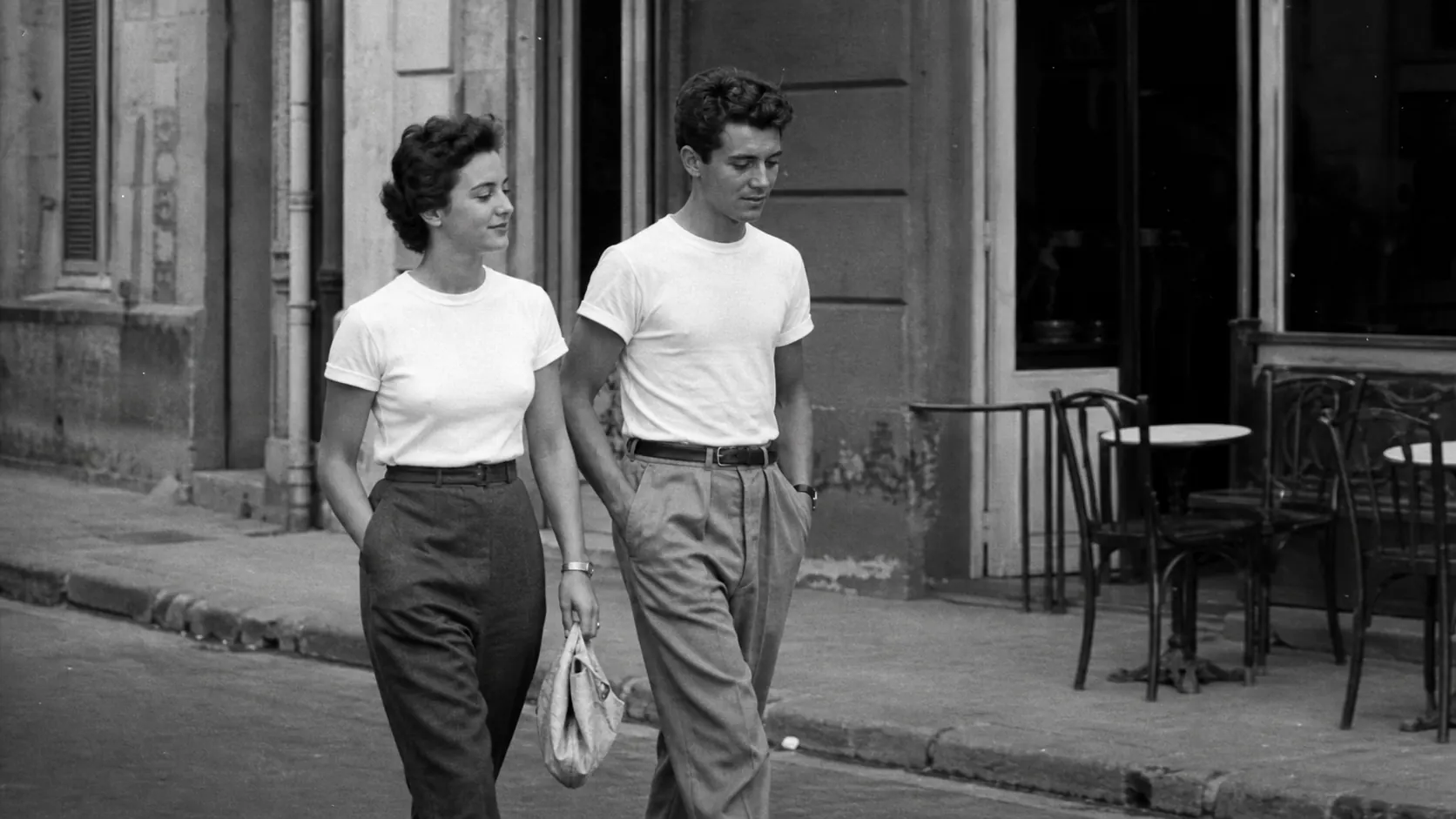
Black-and-white editorial reconstruction of two people in white T-shirts

DISCOVER · STORY

How the hidden layer
reached the street.

A garment of work and intimacy that became a uniform, a screen, a manifesto, a global product — and sometimes a luxury object.

IMAGE · EDITORIAL RECONSTRUCTION

THE THREAD OF THE STORY

The white T-shirt was not invented in a day. It became visible step by step.

The military spread it, sport and work proved its usefulness, cinema dramatised the body it revealed, printing gave it a voice and global industry made it almost omnipresent.

01BEFORE 1900

Before the T-shirt, the underlayer

For a long time, the shirt worn next to the body protected outer clothing as much as it covered the body. In the nineteenth century, knitted or flannel undershirts were used by workers and sailors: absorbent, washable, functional. The future T-shirt did not begin as a fashion object, but within an older history of body linen, work and hygiene.

021930S

From underlayer to possible outerwear

Advertising begins to present the same shape for two uses. In a 1938 Sears catalogue, the “Gob Style All Purpose Shirt” is sold as underwear but also as outerwear. That commercial wording is revealing: going out in a T-shirt becomes imaginable, even if the practice is still far from general.

031950S

The body moves to the foreground

Marlon Brando in A Streetcar Named Desire (1951), then James Dean in Rebel Without a Cause (1955), fixed a lasting image: readable torso, short sleeves, an unadorned garment. They did not invent the outer T-shirt, but cinema amplified its association with youth, sensuality and insubordination. The garment once hidden became powerful precisely because it no longer was.

041980S–2000S

From common object to designer object

The T-shirt moves between street, art and luxury. In 1984, WilliWear Productions presents a collection made with artists, displayed like prints under cellophane and sold in one size. Designers then take up its proportions, seams and apparent neutrality. The same object becomes uniform, souvenir, promotional merchandise or collectible piece.

THREE SHORTCUTS TO AVOID

The history is more interesting than the legend.

“The T-shirt was invented by the Navy.”

Naval uses matter a great deal, but they belong to an earlier evolution of knitted underwear, workwear and industrial production.

“Brando made it visible.”

He made it unforgettable. Athletes, workers, soldiers and civilians were already wearing it alone before 1951.

“It is universal, therefore neutral.”

An apparently simple form always expresses a period: body ideals, announced gender, manufacturing, price and lifespan.

WHY WHITE?

White shows everything.

Associated with washable linen and cleanliness, it also reveals sweat, wear, transparency and jersey quality. On screen, it catches light and cuts the body clearly. In everyday life, it promises simplicity while demanding more care.

This contradiction explains part of its force: it seems anonymous, but immediately reveals its material, cut and the way it has lived.

SOURCES & REFERENCES

This story is verifiable.

Dates are linked to identified collections and institutions. Historical images will be added only when their rights and captions can be established.

Victoria and Albert MuseumName, commercialisation, war, printing and politics →Naval History and Heritage CommandUndershirts in naval regulations and uses →Museum of Modern Art1910s Hanes object and manufacturing work →Cooper Hewitt, Smithsonian Design MuseumWilliWear Artist T-Shirts, 1984 →
Sources consulted on August 13, 2026. The timeline favours checkable facts and flags interpretations.