Wear
Oversized is notjust a size.
Volume, shoulder line and fabric weight decide whether ease feels intentional.
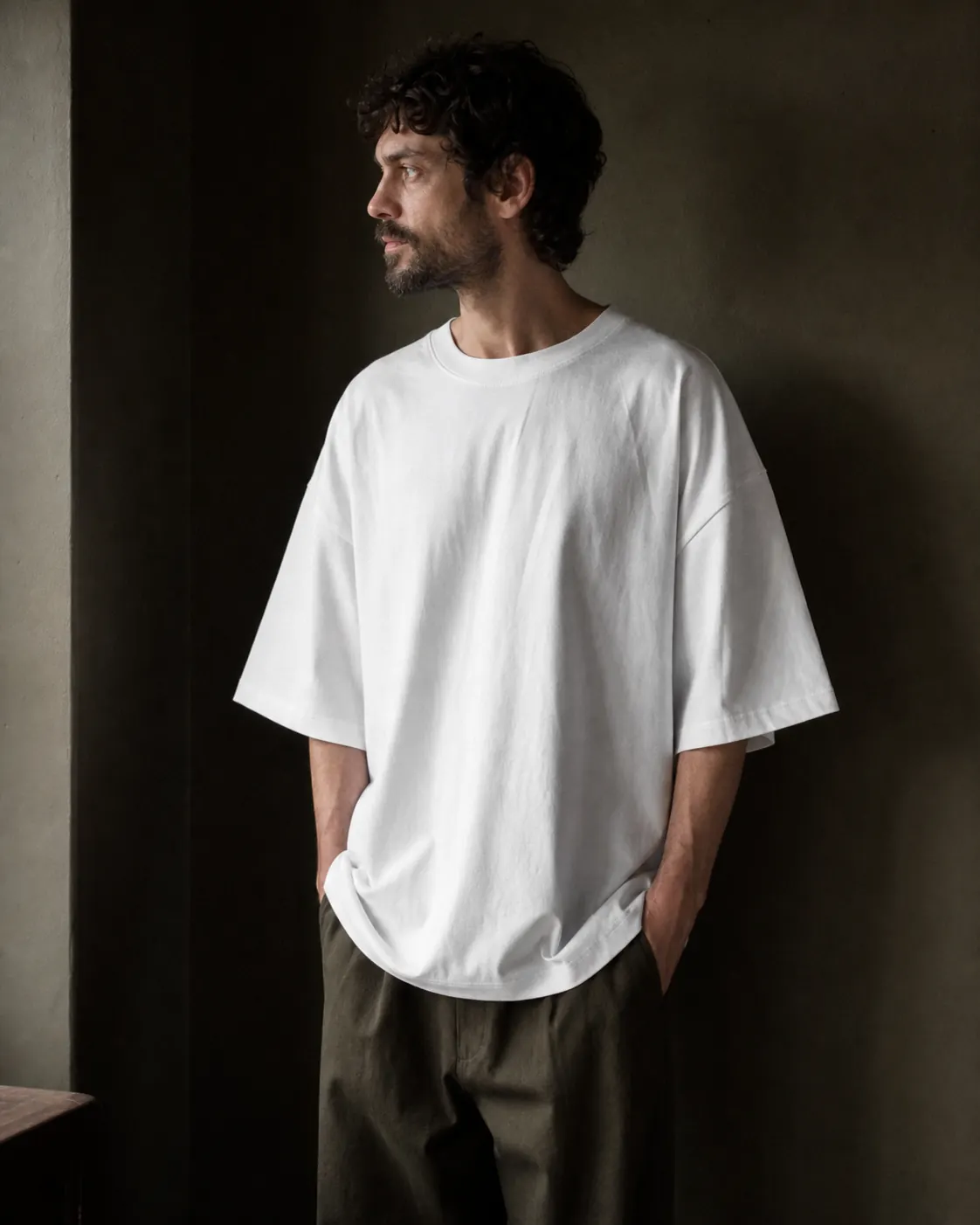
STARTING POINT
Two T-shirts with the same width can carry two very different fit intentions.
An oversized silhouette comes from a set of proportions. To understand it, look at where the shoulder falls, how the sleeve opens and what length accompanies the volume.
The shoulder givesthe first signal.
On an intentionally loose fit, the seam may deliberately drop onto the arm. That shift is supported by the shape of the sleeve and body.
With a simple size-up, every proportion grows without necessarily producing a coherent line.
The sleeve buildsside volume.
Its length, opening and angle change how the T-shirt moves away from the arm. A wider sleeve does not have the same effect if it is short or drops toward the elbow.
Width and lengthmust work together.
A wide, short body creates a compact shape. Wide and long, it extends the mass of fabric. The word “oversized” is not enough: at least two measurements matter.
The label does not describethe silhouette.
An oversized M can be wider than a regular L while still being shorter. Size guides and product measurements are more useful than the reflex to size up.
When those dimensions are not published, TheWhiteTee keeps that absence visible.
IN THE CABIN
Compare dimensions,not only sizes.
Look for the stated fit, width, length and shoulder position. An incomplete record should not become an imagined silhouette.